Author
Your name
A word you made up, an idea, a prediction.
Most of us have a word of our own, or an idea we had before anyone else seemed to. Nobody ever writes down when it started.
Write it here in one line, with your name. Bitcoin keeps the date for good, and nobody can change it or backdate it, us included.
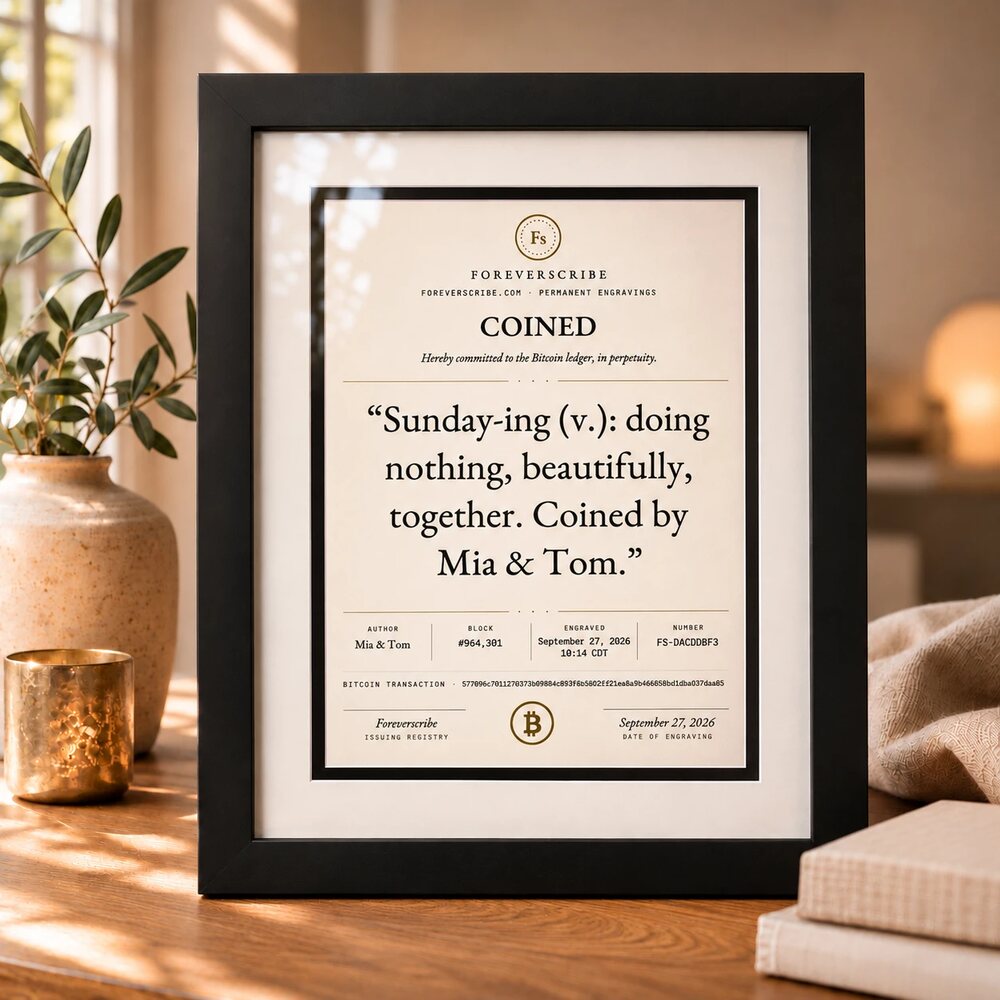
Fill in the parts and see it on the certificate. Nothing is saved or sent until you choose to engrave it.
“Hopecasting (n.): planning the future out loud. Coined by Mia R.”
“A lending library for tools, run by the neighborhood. — Sam K., Oct 2026”
“Prediction: by 2030 most homes will make their own power. — Jo M.”
The word, what it means and who coined it, like “Hopecasting (n.): planning the future out loud. Coined by Mia R.” Up to 80 plain letters.
About every ten minutes Bitcoin adds a block, stamped with the time. Your line usually goes into the next one, and that time becomes its date.
Your certificate has the transaction ID. A public Bitcoin explorer opens your line and its date, for as long as Bitcoin runs.
Only the line goes on Bitcoin. The name on your certificate isn’t on Bitcoin or the public page (only people you share your private link with see it), so if you want the word tied to you, put your name in the line, like Mia did.
Coined
“Hopecasting (n.): planning the future out loud. Coined by Mia R.”
These words go on Bitcoin, for good.
For an invention, a brand or a product name, talk to a lawyer before you share it anywhere, here included.
It proves these exact words existed by that date, and that nobody changed or backdated them. It can't prove nobody used the word before you; someone may have said it first without writing it anywhere.
No. An engraving is a dated public record, not a legal registration. For a brand or a product name, talk to a lawyer about a trademark.
Not quite. A postmark dates the envelope, not what’s inside it, and the US Copyright Office says it’s no substitute for registering. An engraving puts the words themselves on a public, dated record. Neither one is a registration.
No. Your message is public on Bitcoin as soon as it’s sent, and anyone can read it. If you’re not ready to share the word, wait until you are. For a private file, a free tool like OpenTimestamps can date a fingerprint of it without showing what’s in it.
The word, what kind of word it is, what it means, and who coined it: “Glimmerish (adj.): not quite happy yet, but getting there. Coined by Sam K.” A first name and an initial is plenty.
Your name in the message says who coined it, for anyone to read. To show you’re that person, save your ownership card after you order: with it you can send anyone a proof link that shows the engraving is yours, checked against Bitcoin.
They can, but theirs carries a later date. Both stay on Bitcoin, and anyone can see which came first.
No, and it could hurt. Engraving makes the idea public. In the US a public disclosure starts a one-year clock to file a patent; in Europe and many other countries it can rule a patent out. If you might patent it, talk to a patent attorney first.
Yes. Engrave it before it happens, and the date shows you called it. It’s public the whole time, so pick one you don’t mind being wrong about in front of everybody.
$49, paid once by card, everything included, Bitcoin’s fee too. You get a link to share and a certificate to print and frame.
Write it, sign it, pay by card. It usually goes into Bitcoin’s next block, about ten minutes later.
Coming soon